Tuesday, 16 October 2012

Pregnancy and elevated liver enzymes

And we're back....

Today we talked about a case of elevated liver enzymes in a patient who was in her 3rd trimester of pregnancy.


Don't forget about your differential of elevated liver enzymes in a patient who NOT pregnant, since all of those can affect young women as well!

Below is a figure from 'uptodate' which summarizes the differential of "pregnancy associated causes"
Certain features, like Timing (which trimester) or how high the liver enzymes are, can help narrow the differential.

 HERE is a review on liver disease in pregnancy!
Have a good night.

Tuesday, 9 October 2012

drug fever

Welcome back, hope everyone had a nice thanksgiving weekend. 

Today we went through a case of fever which may have been due to infection, malignancy or drug fever.

We went through causes of drug fever such as  hypersensitivity (this can be seen with almost any drug, but commonly seen with antimicrobials and antipsychotics)

Important adverse drug reaction that have fever are Malignant hypertension, NMS and Serotonin syndrome. 

NMS: is a syndrome of 1) altered mental status, 2) fever 3) marked rigidity (with associated CK elevation) 4) autonomic instability: hypertension, tachycardia


It is often seen with antipsychotic medication (usually "typicals", but can be atypical as well) OR withdrawal of dopaminergic medications (e.g. antiparkinsonians)

Treatment is mainly discontinuation of drug (or restarting if withdrawal), and support ( there may possibly be a role for dantrolene or bromocriptine)

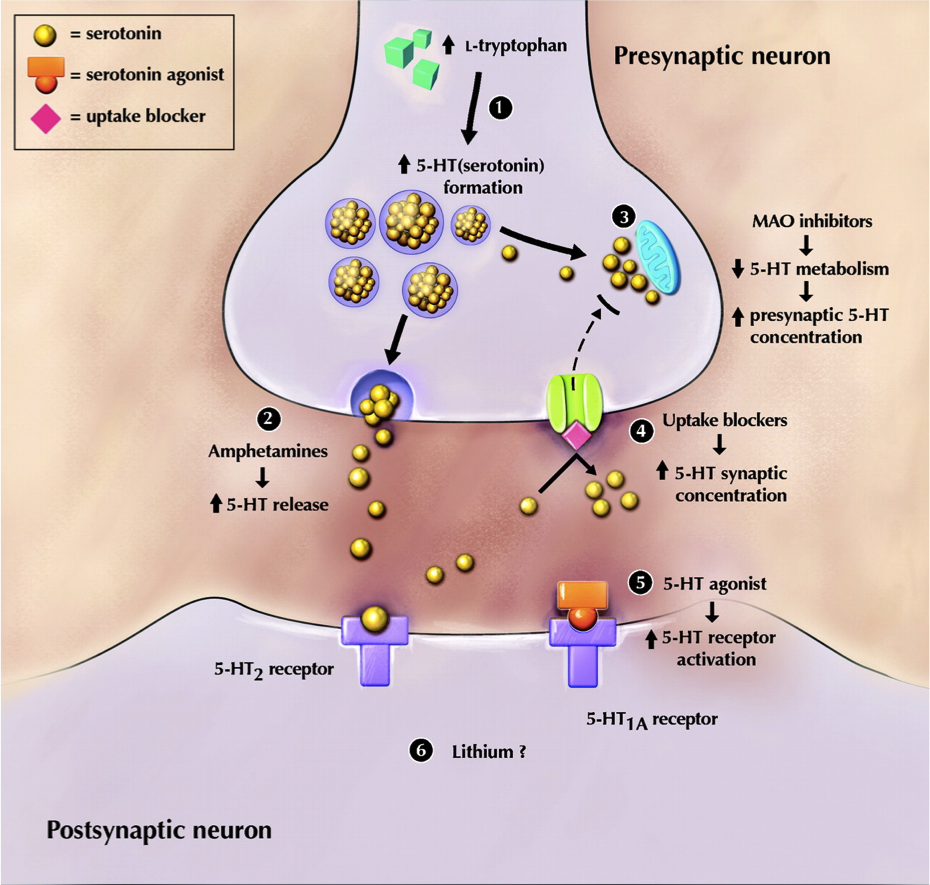
Serotonin sydrome: is a distinct disorder that results from overstimulation of serotonin receptors. (see linked article for various mechanisms)

Birmes P et al. CMAJ 2003;168:1439-1442


Presentation can include mental status change, CNS signs (hyperreflexia, myoclonus, rigidity),  autonomic instability (including fever)

Treatment: Stop serotonergic substance. If severe may need to be cooled or cyproheptadine (antihistamine with antiserotonin effect)

How to differentiate: NMS vs. serotonin syndrome
Serotonin syndrome may have shivering, hyperreflexia, myoclonus, flushing (all uncommon in NMS)


HERE is a great NMS review.

Here is a great Serotonin syndrome review

Tuesday, 2 October 2012

RHF and afib/flut


Today we reviewed right heart failure and hyperthryoidism. 

A great article on isolated RHF can be found HERE. 

Some clues for RHF- worsening of symptoms on lasix, absence of classic LHF symptom,

On physical examination, one may find one or more of the following:

- Elevated JVP 
- Hepatomegaly 
- Ascites
- Peripheral edema
- RV heave
- Palpable P2
- Right-sided S3


Hyperthyroidism can be due to graves, thryoiditis, toxic nodules, exogenous thyroid and drug induced.

This can be worked up as an outpatient by thryoid uptake (a %) and a scan (distribution).


here is a fantastic and recent review of hyperthyroidism!!

anaphylaxis part 2

Monday we reviewed anaphylaxis.

Prior discussion of this post can be found HERE

For an article on the low cross reactivity between cephlosporins and penicillin, see THIS

:o)

Sunday, 30 September 2012

a case a metabolic acidosis

Hope everyone had a good good weekend

Friday, we started with a good example of Anion Gap Metabolic acidosis and reveiwed how to approach acid base problems.

1. pH: acidemia vs alkalosis
2. is it primary met or resp:

3. is there compensation? and is it appropriate? (for acute met acidosis compensation should be ~1:1)
For met acidosis:
4. is there an anion gap? (what is the albumin- if low then anion gap is bigger than appears)--> for every drop of albumin by 10, add 3 to your AG
5. What caused the anion gap? Really the 4 things to think about are:
- Lactic acidosis (hypoperfusion or liver disease)
-Ketone (diabetes, alcohol or starvation)
-Uremia
-Poison/Toxin- ethanol, methanol, ethylene glycol, ASA, isopropyl alcohol

(Think about how many AG points each of the above would raise your gap!!-- Ketone 1:1, Creatitinine 100:1, Lactate 1:2)

6. is there an osmole gap? 

7.Check the delta delta to see if another disorder is also going on.
Basically you just compare the delta AG (e.g. 6 if your AG is 18) to the delta bicarb (e.g. 8 if the bicarb is 17). If they are equal then this is a pure met acidosis.
If delta AG is bigger than delta bicarb: also met ALKALOSIS
if delta AG is smaller than delta bicarb: there is also a non AG met acidosis 


I will review DKA in another post soon.

:O)


Thursday, 27 September 2012

MDS and PE

Thank you Dr. Ann George for yesterday's talk on anemia secondary to MDS.
Here is a good reference for MDS.

Today we went through a case of recurrent PE.

Here is a link to our last talk on PE where we reviewed wells criteria. 


This NEJM study compared Heparin and ALEPLASE (a TPA) vs heparin alone and showed that in SUBMASSIVE PE (and RV dysfunction) but NO hypotention (since that would be the definition of Massive PE) that there was less escalation in therapy with TPA... no change in death.... IE this is still an area of uncertainty.

Indications for thrombolysis is hypotension (sBP<90 mmHg)

Review of acute PE is HERE

Tuesday, 25 September 2012

c dif diarrhea

Welcome block 4!

Today we talked about a case of acute non bloody diarrhea, that turned out to be recurrent cdif. 

Here is a review of acute contagious diarrhea

We focused on the treatment of c dif which is as follows:


First Episode
***If possible stop offending antibiotics***

IF: Mild/Moderate Disease --> Metronidazole OR Vancomycin (PO) duration 10-14d
IF: Severe Disease ( Defined as:   Two of (Age above 60, Febrile, WBC above 15, Albumin below 25)   OR hypotension/shock or Cr greater than 1.5x normal, or toxic megacolon, peritoneal signs, perforated bowel)
consider- Infectious Disease +/- General Surgery Consultation

 Vancomycin (PO) unless severe illeus/toxic megacolon, then vanco PR and Metronidazole (IV) duration 10-14d (Vanco has more rapid symptom resolution and a lower risk of treatment failure).
Relapse
•   First relapse --> can repeat last treatment depending on severity
•   Second relapse --> vancomycin taper. ID consult.

New drug:  Fidaxomicin .. expensive, but targeted bactericidal drug.

Here is a review on C DIF from NEJM. and HERE is an article form annals thats good too. 

Here is the small study that gives hope to probiotics.